REVIEW · KYOTO CRAFT WORKSHOPS
Kyoto : Japanese Calligraphy Workshop with a calligrapher
Book on GetYourGuide →Operated by HidB LLC · Bookable on GetYourGuide
Ink has a way of slowing time in Kyoto. This Japanese calligraphy workshop puts Kanji basics in your hands fast, with an English-speaking calligrapher teaching stroke control right in front of you. You’ll learn the tools, practice fundamentals, then make a take-home piece you picked yourself.
What I like most is the focus on actual technique: you start by building Kanji from a small set of representative strokes, rather than just copying random characters. I also love the personalized support—once you choose a word or Kanji, you get a model and guidance aimed at helping you write it more beautifully, not just quickly.
One consideration: the class is only 1 hour to 90 minutes, so if you get hooked (and you might), it can feel a bit short. Also, the meeting point uses a sign board in front of the entrance—so give yourself extra time to find it, especially if signage outside isn’t obvious.
In This Review
- Key things to know before you go
- Entering a calm Kyoto craft session (and what you’ll do first)
- Tools, brush control, and the five-stroke Kanji foundation
- Picking 愛, 幸, 忍者, or your own Kanji word
- Your final piece: fan, shikishi board, or washi postcard
- Writing your name in Japanese (and why it’s worth doing)
- The photo moment: turning practice into a takeaway you’ll keep
- Price and value: is $51 worth it in Kyoto?
- Who this workshop suits best (and who might want something else)
- Quick practical tips before you go
- Should you book this Japanese calligraphy workshop?
- FAQ
- How long is the Kyoto Japanese calligraphy workshop?
- Do I need any prior experience with Japanese calligraphy?
- Is the instructor speaking English?
- What materials are provided during the workshop?
- What can I make as my final keepsake?
- Can I include my name in Japanese?
Key things to know before you go
- You practice the foundation of Kanji, starting with five representative strokes that build toward real characters.
- Instruction is in English, which makes the steps easier to follow and repeat.
- You choose your own character or word, with popular options like 愛 (Love), 幸 (Happiness), and 忍者 (Ninja).
- You get a personalized model, so you’re not working blindly from a generic example.
- Your final piece is real keepsake material, with choices like a fan, shikishi board, or washi postcard.
- You can write your name in Japanese, then finish with a commemorative photo together with your artwork.
Entering a calm Kyoto craft session (and what you’ll do first)
This workshop is built around one simple idea: learn by doing. You’re not just watching someone write; you’re holding the brush and repeating strokes until your hand starts to understand the rhythm. The whole session is designed to go from tools → basic motion → your chosen character → finished souvenir.
Right at the start, you’ll learn how to use the brush and ink, plus what you’re looking for in Japanese characters. Even if you’re starting from zero, you’ll get a clear plan for what to practice and why. That matters in calligraphy, because small differences in stroke order and brush pressure can change how the character feels.
And yes, it’s also a great rainy-day option. If Kyoto weather is doing its unpredictable thing, this kind of indoor hands-on activity keeps your day moving without needing a backup plan.
You can also read our reviews of more tours and experiences in Kyoto

Tools, brush control, and the five-stroke Kanji foundation
The core of the lesson is the basics of Japanese characters, with extra attention on Kanji. You begin with tool basics and then move into stroke practice. The workshop centers on five representative strokes that act like building blocks for Kanji writing.
Here’s why that’s a smart approach. If you jump straight into whole characters, you can end up copying shapes without understanding how the strokes behave. With the five-stroke foundation, you start learning how to make the long pulls, the angled turns, and the finishing flicks that give Kanji its structure. After that, the character you choose becomes less like a mystery and more like a combination of motions you can repeat.
You also explore how Kanji works alongside other script options such as Katakana. You don’t need to master everything here. The point is to understand what you’re looking at, and to get comfortable enough that your final character feels achievable.
Picking 愛, 幸, 忍者, or your own Kanji word
One of the most satisfying parts is choosing what you want to write. You can select a word or Kanji character you’ll actually care about, rather than picking something random from a list. Popular examples include 愛 (Love), 幸 (Happiness), and 忍者 (Ninja), which are perfect because they’re clear and meaningful.
Once you decide, the calligrapher provides a personalized model. That means you’re not just tracing the same template for everyone. You’ll get specific points for writing your character beautifully—this is where the class feels like it clicks. You can watch the technique, then immediately try again with guidance.
If you want a “Kyoto memory” that’s personal (not just a generic souvenir), this is the moment to slow down and choose something that matches your trip. Love and happiness are classic for a reason, but your best choice is the character that will make you smile when you see it later.
Your final piece: fan, shikishi board, or washi postcard
After you’ve practiced the strokes and received your model, you create your final artwork. This is where the workshop turns from practice into a keepsake you’ll want to display.
You can select from:
- A folding fan
- A shikishi board
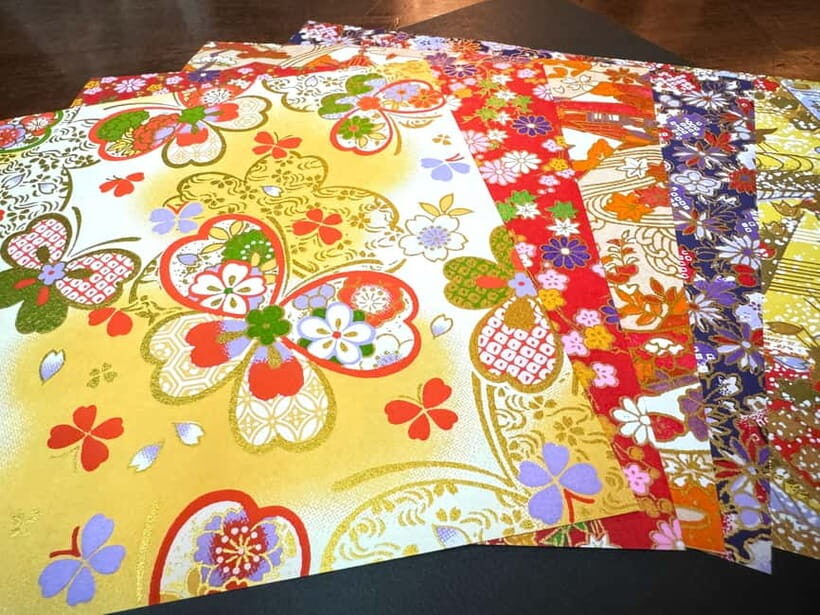
- A washi postcard
Each option changes how you think about your writing. A fan can encourage a more dynamic placement, while a shikishi board usually feels like a centered, framed composition. A washi postcard gives you a smaller, portable format that still keeps the handmade feel. You’re basically picking the canvas shape and size your brushwork needs to fit.
This is also a nice detail for anyone planning a gift. These pieces are made for taking home, and the workshop supplies what you need rather than leaving you to source materials on your own.
One practical note: ink can stain, so wear comfortable clothing you don’t mind getting a little messy. Brushwork is hands-on, and ink is part of the process.
Writing your name in Japanese (and why it’s worth doing)
The workshop also lets you write your name in Japanese on your final piece. This is a popular add-on because it personalizes the artwork even more than choosing a character alone.
Your name write-up helps you go one step further: instead of just learning a script example, you’re creating something that feels like it came from you. It’s especially fun if you’re traveling with someone, because you’ll both end up with a unique character or name version rather than identical souvenirs.






The photo moment: turning practice into a takeaway you’ll keep
At the end, there’s a commemorative photo taken together with your completed artwork. It’s a small thing, but it helps you lock in the memory. When you’re making something handmade, it’s easy to focus only on getting through the strokes. The photo gives the moment structure—finished piece in hand, good record of what you made, and a reminder that you actually learned the process, not just watched it.
The workshop also runs for 1 hour to 90 minutes, so the flow stays efficient. You’ll have time to practice, choose, write, and finish without feeling like the session drags.
Price and value: is $51 worth it in Kyoto?
The price is listed as $51 per person, and for what you get, it’s fairly strong value. Here’s what’s included:
- Japanese calligraphy workshop
- Brush and ink usage instruction
- Basic stroke practice and Kanji exploration
- Personalized Kanji model
- Souvenir creation (fan, shikishi board, or washi postcard)
- A commemorative photo with your artwork
You’re not paying extra for materials or the final keepsake. That’s a big deal in Japan, where quality workshop supplies can be priced separately. The value also comes from the teaching: you get step-by-step stroke practice plus personalized guidance once you pick your character. That combination is what usually makes a class worth it rather than just a cultural activity.
Costs not included are straightforward: transportation to the venue and meals/drinks. So if you can plan your day so you’re nearby before class, you’ll get even more value out of the $51.
Who this workshop suits best (and who might want something else)
This is a great fit if you want:
- A hands-on Kyoto activity that doesn’t require prior experience
- Real technique practice, not just decoration
- A personal take-home artwork (with your chosen character)
- English instruction that keeps the steps clear
It’s especially good for rainy weather, and for people who like crafts where the outcome looks impressive even when you’re a beginner. The lesson is structured so you don’t need to already know calligraphy to participate.
Where it may not fit is if you prefer long, slow sessions where you can keep refining for hours. With 1 hour to 90 minutes, you’ll learn the basics and produce a finished piece, but there’s limited time for advanced repetition. If you want serious calligraphy training, you’d likely need a longer course. But for a first taste in Kyoto, this is a solid “learn and take home” format.
Quick practical tips before you go
- Wear comfortable clothes you don’t mind if ink marks them.
- Plan extra minutes to locate the entrance. The meeting point is described by a sign board in front of it.
- Pick your character ahead of time if you’re picky. If you’re not, the instructor can guide you once you arrive.
- If writing your name matters to you, decide early so you can plan space on your final piece.
Should you book this Japanese calligraphy workshop?
Yes—if you want a beginner-friendly Kyoto activity that turns into something tangible. The best reason to book is the structure: you learn tool basics, practice the foundational strokes for Kanji, get a personalized model once you choose your character, and then create a souvenir you can keep. That sequence is what makes the class feel worth the money.
I’d book it even if your calligraphy experience is zero. The workshop is designed for no prior experience, runs in English, and includes materials plus your final artwork options. The only true downside is the time limit—so go in ready to learn the basics and enjoy finishing strong.
FAQ
How long is the Kyoto Japanese calligraphy workshop?
The workshop lasts about 1 hour to 90 minutes. Check availability to see the starting times.
Do I need any prior experience with Japanese calligraphy?
No prior experience is required. The class includes basic stroke practice and guidance for beginners.
Is the instructor speaking English?
Yes. The instructor provides instruction in English.
What materials are provided during the workshop?
You’ll receive instruction on brush and ink use, and all necessary materials are provided for your practice and final artwork.
What can I make as my final keepsake?
You can choose from a folding fan, a shikishi board, or a washi postcard for your final piece.
Can I include my name in Japanese?
Yes. You can write your name in Japanese as part of the final artwork, and you’ll have a commemorative photo taken with it.