REVIEW · KYOTO CRAFT WORKSHOPS
Japanese Calligraphy – Shodo – Lesson (near Kyoto Station)
Book on Viator →Operated by Kyoto MK · Bookable on Viator
Ink on paper, instant Kyoto. In about an hour, you’ll learn Japanese calligraphy (shodo) the hands-on way, with guided brushwork and ink control, right near the station. I love how the workshop is set up so you can start immediately, since the class provides the brush, ink, and washi paper.
I also love the personal souvenir payoff: you’ll practice basic kanji and then write your own name in kanji with staff help. One possible drawback: the meeting spot by the MK taxi stand can be a little tricky to find at first, so plan a few extra minutes.
In This Review
- Key things to know before you go
- Why a shodo lesson near Kyoto Station makes sense
- Finding Kyoto MK and getting set up quickly
- Brush, ink, and washi paper: what you actually learn in the first part
- Writing kanji for Kyoto, forever, and your name
- The souvenir value: what you bring home, not just what you learned
- Timing and pacing: how you fit it into your day
- Family-friendly shodo: what kids get out of it
- Price and value for a Kyoto calligraphy keepsake
- Who should book this shodo lesson (and who might want a longer class)
- Should you book Japanese calligraphy at Kyoto MK?
- FAQ
- How long is the Japanese calligraphy lesson?
- Where do I meet the group near Kyoto Station?
- Is there public transportation nearby?
- What is included in the price?
- Can kids participate?
- What will I write during the class?
- Will I be able to take my calligraphy home?
- Is the class limited in group size?
- What ticket type do I need?
- What is the cancellation policy?
Key things to know before you go
- Small group size (max 10) keeps the lesson calm and gives you time for questions.
- Everything is provided: brush, ink, and washi paper, so you’re not hunting for supplies.
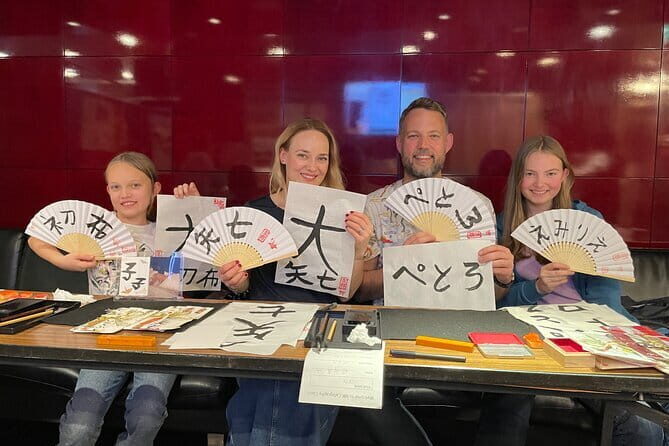
- You’ll write a mini character set including kanji for one, A, forever, and Kyoto.
- Name-to-kanji support means staff help you pick kanji options and explain meanings.
- Family-friendly practice includes kid-friendly decorating and extra chances to write.
- Take-home shodo keepsakes go beyond a single sheet, including finished calligraphy and added items.
Why a shodo lesson near Kyoto Station makes sense
Kyoto is great for long days, but you still need one activity that’s low effort and high satisfaction. This Japanese calligraphy workshop hits that sweet spot: it’s short, structured, and close enough to your Kyoto Station area base that you won’t waste half a day getting there.
The lesson is built for beginners. You’re not expected to already know stroke order or brush pressure. Instead, you start with how to hold the brush and how to apply ink, then you practice specific kanji step by step. By the end, you have something real you made, not just photos of other people’s work.
What makes it extra practical is the small-group setup. With a maximum of 10 people, you get more hands-on attention than you’d expect in a bigger class. That matters because calligraphy is one of those crafts where small corrections help a lot, especially when you’re trying to make strokes look intentional.
You can also read our reviews of more tours and experiences in Kyoto

Finding Kyoto MK and getting set up quickly
You meet at MK Taxi VIP Station near Kyoto Station, at the Hachijo Exit taxi stand. The exact address listed is in the Minami Ward Higashikujō area, next to the Ibis Styles Kyoto Station property, so you’re in the right zone for transit and late-day plans.
Here’s the best way to avoid stress: when you come out of the Hachijo Exit, look for the MK taxi area and the nearby MK building. One helpful tip from experience on finding the spot is to scan for the MK building diagonally across the street from the exit. That saves you from wandering with wet-ink nerves and a limited time window.
This is also the kind of tour where a mobile ticket helps. You don’t need to print anything. Still, get there a bit early so you can settle in, pick your seat, and get your first practice strokes going while everyone is starting together.
Brush, ink, and washi paper: what you actually learn in the first part
The class starts with instruction that feels simple, but it’s the foundation of good shodo. You’ll get a lecture on how to use the brush and how to apply ink. In practice, that means learning how much ink you load and how your brush movement changes the line.
That matters because ink can behave differently depending on how it’s brushed across washi paper. Too light and your strokes fade; too heavy and your line can spread. Even in one hour, the instructor-style teaching helps you avoid the most common beginner mistakes.
Then you move into basic characters. You’ll practice kanji for themes like one, A, forever, and Kyoto. The goal isn’t memorizing everything forever. It’s learning how to break the word into strokes, keep your brush moving with control, and end with a shape that looks balanced.
If you’ve ever tried to write kanji from a guide on your phone, you know how easy it is to feel lost. Here, the class gives you a guided path, so your strokes aren’t random. You build confidence fast because you’re always doing the next step with help right there.
Writing kanji for Kyoto, forever, and your name
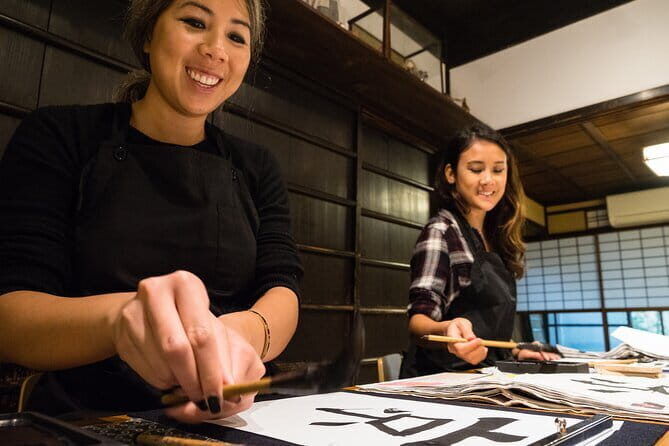
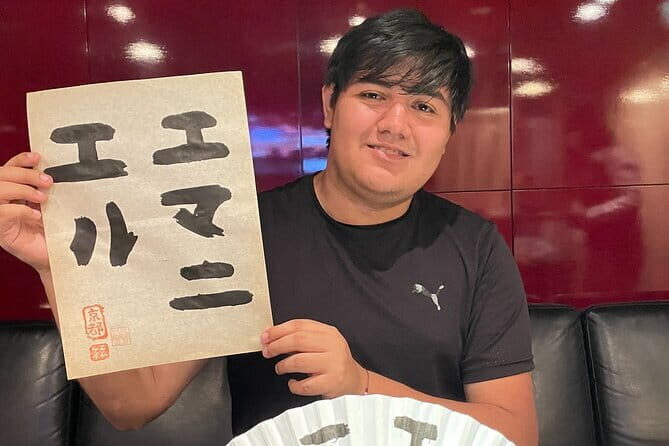
After the basic character practice, you’ll write your own name in kanji. This is the part most people end up talking about later, because it turns “learning a skill” into a personal object you can keep.
You’ll get assistance choosing kanji options and understanding meanings. For example, the class materials and example mappings include names like Brian being shown as 武礼安, and Liz being shown as 梨図. The point isn’t that your name will always map exactly the same way. The value is that staff help you connect possible kanji choices to meanings, so your final result feels intentional.
You’ll also practice more than one writing target. The lesson includes a chance to do favorites beyond the basic set, and some sessions include guidance across scripts like kanji as well as other Japanese writing styles. That flexibility can be a fun way to compare how a word looks in different forms, especially if you want your keepsake to reflect more of your personality than just a single kanji.
And yes, Kyoto-specific content is part of the workshop. The basic character practice includes kanji for Kyoto, which helps the whole lesson feel tied to place, not like a generic class you could take anywhere.
The souvenir value: what you bring home, not just what you learned
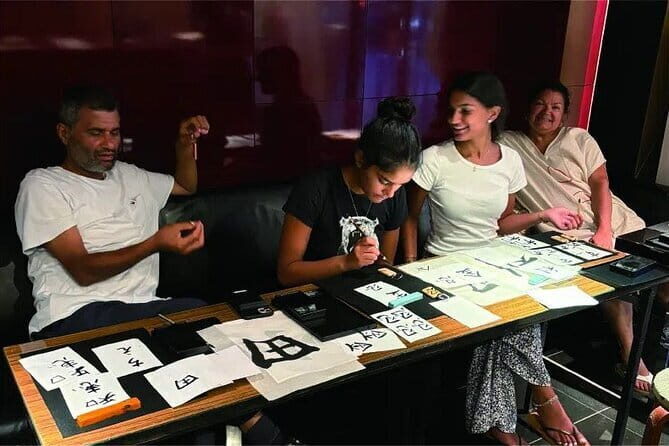
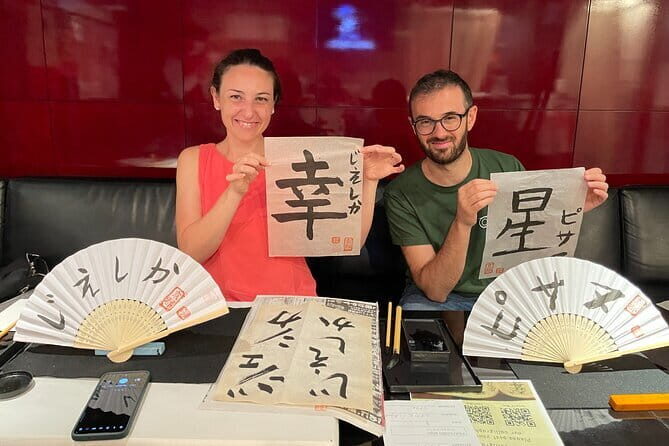
The best shodo souvenir is the one that looks good on a shelf and feels like it belongs to you. This workshop is designed for that. You take home your finished calligraphy as a keepsake, and it’s more than one random page.
You can expect a few different take-home formats. One is a scroll created from the kanji you write. Another is a set of personal pieces tied to your name and chosen words. In several cases, the souvenir set can include items that turn the calligraphy into something more decorative, like a photo frame and custom fans created with your calligraphy.
That difference matters. A classroom printout is easy to forget. A calligraphy scroll or wearable-style item you made yourself tends to stick around longer. It’s the kind of Japan memory that feels personal, not souvenir-cookie-cutter.
If you’re traveling with family, this is also a win because kids usually get something they can show off quickly. One parent-style highlight here is that kids often get multiple decorating chances and plenty of practice time, which keeps the session fun instead of turning into a passive watch-and-try.






Timing and pacing: how you fit it into your day
The session runs about 1 hour. That makes it ideal as a morning reset or a last-day activity when you want something memorable without committing to a full half-day tour.
The pacing follows a clear pattern: instruction, basic practice, then personal-name writing. Because the group size is capped at 10, you’re not stuck waiting for the instructor to finish helping someone else before you touch your brush again. You’ll get enough repetition to feel like you made progress.
One more reason this timing works: you don’t need a pre-planned route to make it happen. The meeting point is near Kyoto Station, so you can tack it onto a transit day, a shopping day, or a Gion-area wander day without complicated logistics.
Family-friendly shodo: what kids get out of it
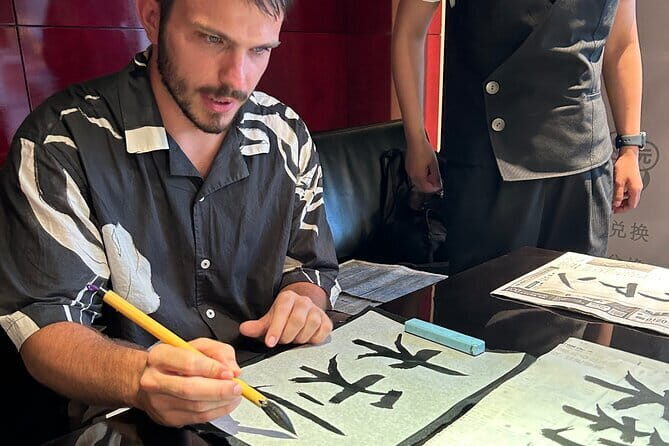
Japanese calligraphy is sometimes seen as slow and quiet, but this class is set up to be approachable for kids. The experience is described as family-friendly, and there are activities available for children.
In real terms, that means kids aren’t just expected to sit still while adults learn. They get practice and chances to participate in the creation process. Some classes also include extra items to decorate with calligraphy, and that helps young visitors feel ownership in a way that plain writing practice alone might not.
For adults traveling with children, this also reduces stress. You don’t have to design an alternative plan for kids while you take the class. The workshop is built to work as a shared activity.
Price and value for a Kyoto calligraphy keepsake
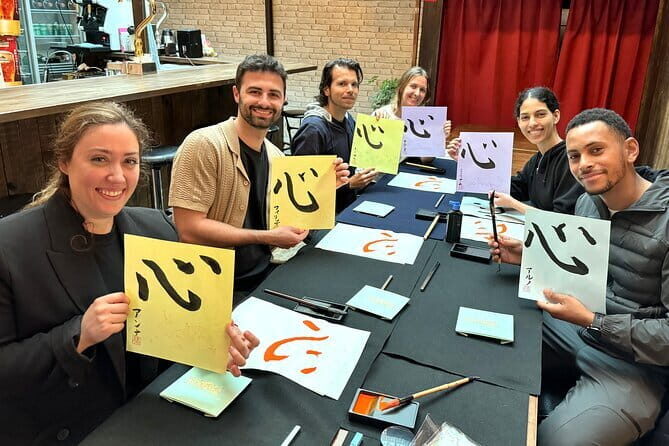
At $50.40 per person, this feels like a “pay once, take home something real” kind of experience. The biggest value lever is that you’re not paying extra for supplies. Brushes, ink, and washi paper are included, and that can be a hidden cost if you tried to DIY it in Kyoto.
You’re also getting instructor guidance. That’s the hard part to replicate alone. Stroke control and ink application are where people usually struggle, and those are exactly what the class teaches early on.
Is it expensive compared with a free cultural walk? Sure. But compare it to the cost of buying your own washi paper and inks plus the time to learn from scratch. For one hour, with a finished personal keepsake at the end, it’s a practical value.
Also, since it’s near Kyoto Station and easy to fit into a day, you aren’t spending extra time coordinating. In travel terms, saving time is often part of what you’re really paying for.
Who should book this shodo lesson (and who might want a longer class)
This workshop is a great fit if you:
- Want a beginner-friendly introduction to Japanese calligraphy without guessing on your own.
- Like the idea of taking home a personal souvenir made with your name and chosen words.
- Are traveling with family and want an activity that works for both kids and adults.
- Prefer small-group attention over a large, fast-moving experience.
You might want something else if you’re chasing deep mastery. This is a one-hour lesson, so you’ll learn fundamentals and create a finished product, but you won’t turn into a calligraphy expert in 60 minutes. Still, for most travelers, that’s exactly why it works.
Should you book Japanese calligraphy at Kyoto MK?
If you want a Kyoto memory you can hold—one that’s made by your hand and tied to Japanese writing—this is an easy yes. The small group size, the included materials, and the personal name-in-kanji keepsakes make it feel worth it even when you’re tired or short on time.
Do one thing to make your experience smoother: arrive with enough time to find the MK Taxi VIP Station area near the Hachijo Exit. Once you’re in, the instruction is friendly and patient, and you’ll be writing your own kanji before you know it.
If you’re the kind of traveler who likes crafts, words, and tangible souvenirs, book it. It’s the rare activity where you leave with something better than a story—you leave with the paper and ink to prove it.
FAQ
How long is the Japanese calligraphy lesson?
It’s about 1 hour.
Where do I meet the group near Kyoto Station?
You meet at MK Taxi VIP Station, Kyoto Station Hachijo Exit taxi stand, at the location listed near Ibis Styles Kyoto Station.
Is there public transportation nearby?
Yes, the meeting point is near public transportation.
What is included in the price?
The lesson includes use of brushes, ink, and washi paper.
Can kids participate?
Yes. It’s described as family-friendly, and there are activities available for children.
What will I write during the class?
You’ll practice basic kanji characters and then write your own name in kanji with staff assistance.
Will I be able to take my calligraphy home?
Yes. You take home your finished calligraphy creations as souvenirs.
Is the class limited in group size?
Yes, it has a maximum of 10 travelers.
What ticket type do I need?
You use a mobile ticket.
What is the cancellation policy?
Free cancellation is available up to 24 hours before the experience starts for a full refund.