REVIEW · GEISHA & MAIKO TOURS
Authentic Kyoto Gion Geisha/Maiko Cultural Experience
Book on Viator →Operated by JTB Global Marketing & Travel Inc. · Bookable on Viator
Gion has a secret door. This small-group experience brings you into a traditional teahouse in Kyoto’s Gion district for a maiko or geiko performance, with an English-speaking guide translating and adding context as you go. Gion feels close and personal, not like a hurried stop on a checklist.
I love the relaxed format: the group is capped at 10 travelers, so you get real conversation time rather than just watching from a distance. I also love the built-in rhythm—Hanamikoji Street first, then an intimate tatami-room visit with dance, matcha, and photo opportunities.
One consideration: it’s not a budget activity. At about $155.22 for roughly 1.5 hours, you’re paying for access, and you can’t pick whether you’ll meet a maiko or a geiko since it depends on the day.
In This Review
- What makes this Gion teahouse experience worth it
- First stop: a focused walk on Hanamikoji Street
- Inside the teahouse: tatami, tea, and a live maiko or geiko performance
- You meet a performer, plus a tea master
- Dance and music: the moment you came for
- Matcha tea ceremony (with ceremonial care)
- Why the small group (max 10) changes everything
- The guide is the real translator of culture
- Photo time: capture it, but keep the room in mind
- Value check: what $155.22 is actually buying
- Practical tips so the teahouse part goes smoothly
- Who should book this Gion experience
- A quick logistics snapshot: where you start and where you end
- Should you book this maiko/geiko teahouse experience?
- FAQ
- Is this experience in Gion and how long does it take?
- What’s the starting meeting point?
- Where does the tour end?
- How big is the group?
- Can I choose whether I meet a maiko or a geiko?
- What happens during the teahouse portion?
- Do I need to bring socks or special clothing?
- Is a mobile ticket provided?
- What are the age limits?
What makes this Gion teahouse experience worth it
- Small group (max 10): better questions, better viewing, and less crowd pressure
- English translation + context: the guide helps you understand what you’re seeing and why it matters
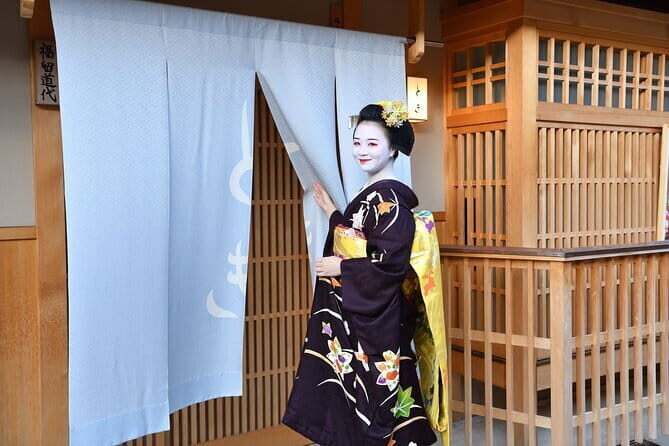
- Maiko or geiko plus tea master: traditional dance viewing followed by a ceremonial matcha tea moment
- Photo time included: you can capture the experience during the event (not just before and after)
- Built-in pacing: a short, scenic walk along Hanamikoji Street before you settle into the tatami room
First stop: a focused walk on Hanamikoji Street
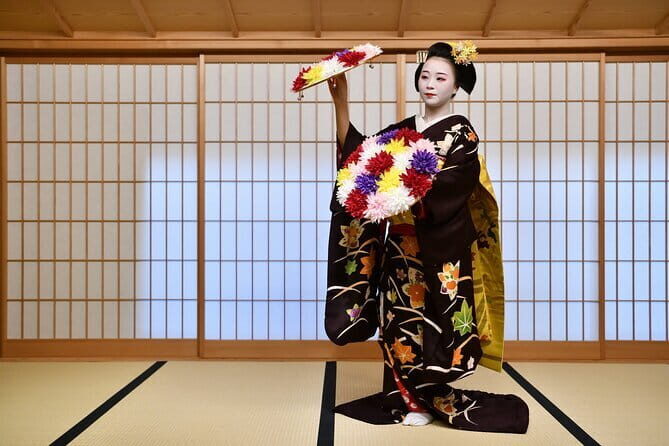
You start near Gion-Shijo Station at 1 Chome Miyagawasuji. From there, your English-speaking guide takes you on a short stroll through Gion and into the historic atmosphere people come to Kyoto for. The time here is brief (about 15 minutes), which is actually a smart choice: it gives you Gion context without turning your whole outing into walking-only sightseeing.
What I like about this opener is that it sets the frame before you hit the performance. If you’re trying to understand geisha culture, you want the basics first—what Gion is, how it works as a district, and what etiquette looks like—so the teahouse moment lands better. You also get oriented quickly, which helps if you plan to continue exploring Gion afterward.
There’s not much downside to this stop because it’s short. The main thing to know is that you’ll be walking and you’ll want to stay ready for the teahouse portion right after.
You can also read our reviews of more tours and experiences in Kyoto.


Inside the teahouse: tatami, tea, and a live maiko or geiko performance
The main event happens in the teahouse, where your experience runs about 1 hour. This is where the atmosphere shifts from “Kyoto street scene” into something calmer and more formal. You’ll sit in a tatami room designed for the performance, and you’ll be guided through what’s happening instead of being left to guess.
You meet a performer, plus a tea master
During the teahouse part, you’re accompanied by either a maiko or a geiko along with a tea master depending on the day. You can’t choose which one you get. That’s not a flaw, though—it’s part of the realism. These traditions have their own scheduling, and the value is seeing the culture as it actually operates.
Dance and music: the moment you came for
You’ll watch a traditional dance performance, and you’ll have time to see it properly because the setting is small and controlled. In several accounts, the entertainment doesn’t stop at dance—some descriptions include instrument playing by the teahouse owner, a former geiko—so the evening can feel more layered than a simple show-and-go.
Matcha tea ceremony (with ceremonial care)
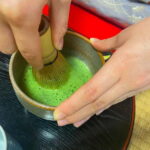
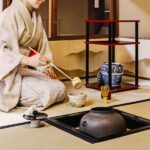
After the dance, you move into the matcha tea experience. The key point here is not just drinking matcha—it’s the pacing and etiquette around it. A tea ceremony is a lesson in attention: how you receive something, how you pause, and how hospitality shows up in details.
Some reports also mention extra treats like matcha ice cream and a small flour sweet alongside tea. Since those aren’t listed as guaranteed in the core inclusions, think of them as a pleasant possibility, not a promise.




Why the small group (max 10) changes everything
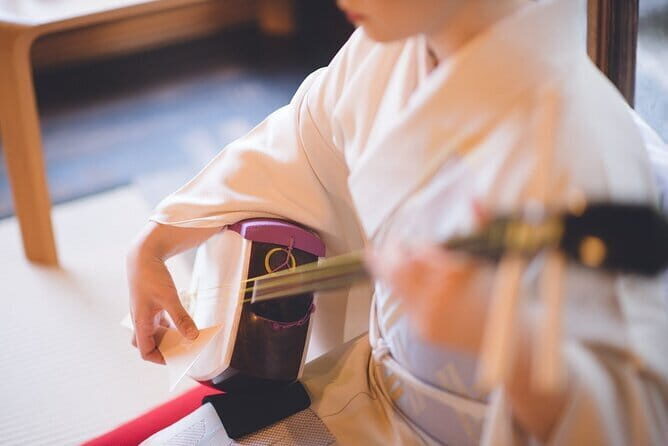
Most Kyoto “culture” experiences become hard to enjoy when you’re in a crowd. Here, the group size stays small, with a maximum of 10 travelers. That matters because geiko culture isn’t meant to be loud and rushed. When the room isn’t packed, you can watch the performance with less distraction and hear what your guide is translating.
It also improves your interaction. The best part of this experience is the chance to ask questions and get context directly. Several guide accounts highlight Q&A time as a standout feature, and that only works when the group can pause and listen rather than constantly move along.
If you want a respectful experience where the focus stays on the performance and the conversation—not on squeezing into seats—this format is the right fit.
The guide is the real translator of culture
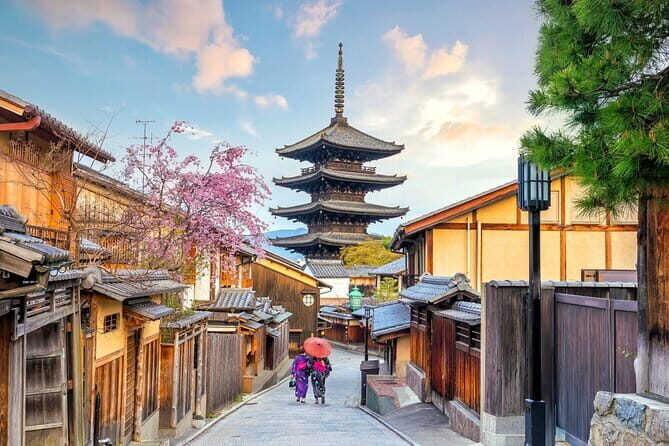
On paper, this tour includes an English-speaking guide. In practice, that guide can decide whether you simply watch something beautiful or you truly understand what you’re seeing.
Many detailed accounts praise guides by name, including Yuko, Yoshi, Tokodo?, Tomonika, and Youko. A common theme in these descriptions is that the guide doesn’t just translate lines; they connect the dots—explaining what people are doing, how Gion works, and what growing up in Kyoto looks like in relation to the tradition.
So here’s the practical takeaway: come with curiosity, not a checklist. Ask your guide what to pay attention to during the dance. If something feels formal or symbolic, it’s worth asking why. The experience is designed to make those questions possible.
Photo time: capture it, but keep the room in mind
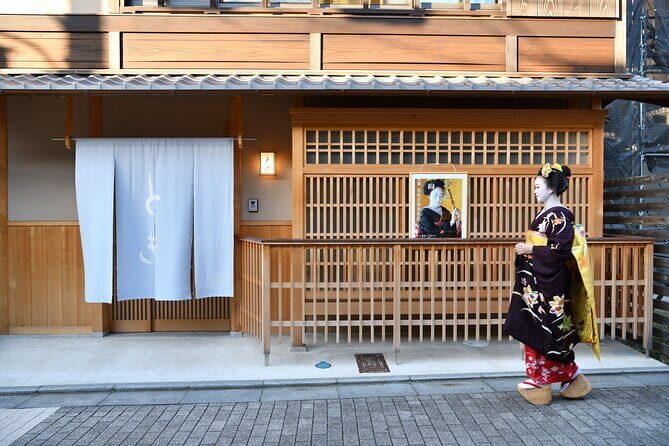
This experience includes photo opportunities during the event. That’s a big plus because you’re not stuck taking blurry, awkward street photos from behind glass.
Still, this is a teahouse setting with etiquette. The tour explicitly asks you to cooperate in keeping tatami spaces clean and follow house behavior instructions (you’ll be guided on what’s appropriate when you arrive). In other words: use your camera, but treat the room like a performance space, not a theme park.
A helpful mindset: take fewer photos, but take them at the moments your guide says are the right time. That way your pictures look intentional instead of chaotic—and you’ll enjoy the experience more than you might expect.
Value check: what $155.22 is actually buying
At $155.22 per person for about 1 hour 30 minutes, it’s not a casual add-on. You’re paying for three main things:
1) Access and time in a teahouse setting where the performance and tea ceremony happen as part of a small-group visit.
2) English interpretation that turns what could be a scripted viewing into a conversation with context.
3) A carefully timed experience: quick Gion orientation, then a concentrated event—no half-day dragging, no long commutes between stops.
You might also notice that the tour uses a mobile ticket and runs with tight structure, which helps the whole thing feel smoother. And because the max group size is 10, you’re not just paying for the show—you’re paying for the chance to experience it at a human pace.
If you’re the type who enjoys crafts, etiquette, and meaning behind formal gestures, this price can feel fair. If you only want general sightseeing in Gion, you’ll likely find cheaper options; but you wouldn’t get the same teahouse access and guided interpretation.
Practical tips so the teahouse part goes smoothly
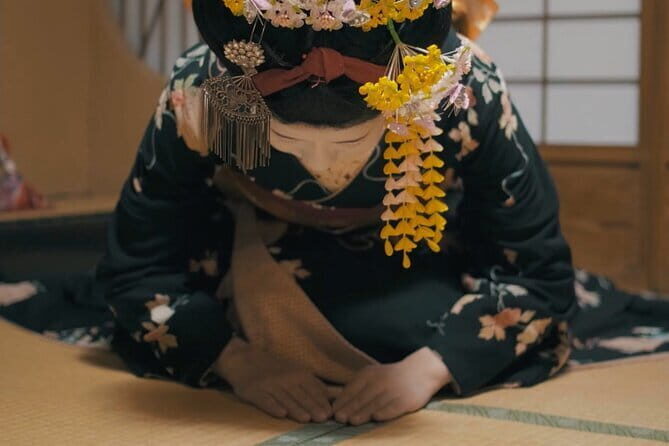
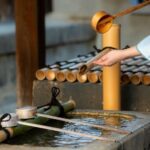
This is where people can make or break their own experience. The tour asks you to wear socks. If your feet, clothes, or bag are wet—especially on rainy days—wipe water off with a towel before entering the teahouse. The goal is simple: keep tatami clean.
Here’s what I’d do to make your life easier:
- Wear socks you’re comfortable in (no slipping, no thin ones that’ll hurt).
- If it’s rainy, carry a small towel and a zip bag for wet items.
- Wear shoes that are easy to manage before and after the short street portion.
Also, remember that teahouses are quiet and controlled spaces. Keep your phone use light during the event, and follow whatever behavior guidance your guide shares on site.
Who should book this Gion experience
This tour fits best if you:
- Want a guided look at geisha culture, not just photos outside.
- Appreciate formal traditions like dance and tea rituals.
- Like small-group settings where you can ask questions.
- Prefer a shorter outing (about 90 minutes) that you can pair with the rest of your Kyoto plans.
It may feel less ideal if you’re going just to “see what happens.” The whole experience works because you’re meant to pay attention, ask questions, and respect the etiquette of the room.
There are also clear age rules. Children 0–5 cannot join. For anyone under 18, parental permission in writing is required, and anyone under 15 or not yet in middle school must be joined by a parent or guardian.
A quick logistics snapshot: where you start and where you end
You begin at Gion-Shijo Station (1 Chome Miyagawasuji, Higashiyama Ward). You’ll walk a short stretch with your guide and then head to the teahouse in Gion. The experience ends at the teahouse area around Gionmachi Minamigawa, Higashiyama Ward.
The tour duration is around 1 hour 30 minutes, including the short Gion street segment and the teahouse visit. It’s also built around a mobile ticket, which keeps everything simple once you have it ready.
Should you book this maiko/geiko teahouse experience?
I’d book it if you want a respectful, small-group look at geisha culture with an English guide and real time to ask questions. The combination of live dance, matcha tea, and photo opportunities inside a traditional tatami room is exactly the kind of Kyoto experience that feels rare once you’re on the ground.
Skip it if you’re mainly shopping for a budget-friendly Gion walk, or if you don’t care about etiquette, translation, and understanding what’s happening. This experience is at its best when you’re ready to slow down for the tea, watch the dance closely, and use your guide to make sense of the details.
FAQ
Is this experience in Gion and how long does it take?
Yes, it’s in Kyoto’s Gion district. The total experience runs about 1 hour 30 minutes (around 15 minutes walking on the street and about 1 hour in the teahouse).
What’s the starting meeting point?
You meet at Gion-Shijo Station at 1 Chome Miyagawasuji, Higashiyama Ward, Kyoto 605-0801.
Where does the tour end?
The tour ends at the teahouse in Gion, near Gionmachi Minamigawa, Higashiyama Ward, Kyoto 605-0074.
How big is the group?
The group maximum is 10 travelers.
Can I choose whether I meet a maiko or a geiko?
No. During the teahouse experience, you’ll be accompanied by either a maiko or a geiko depending on the day, along with a tea master.
What happens during the teahouse portion?
You watch a traditional dance, have a tea ceremony experience with matcha, and take photos in the tatami room. You’ll also have time to interact with the performer and ask questions with translation support.
Do I need to bring socks or special clothing?
You should wear socks. The tour also asks you to wipe off wet feet, clothes, or bags before entering the teahouse to help keep tatami spaces clean.
Is a mobile ticket provided?
Yes, the experience uses a mobile ticket.
What are the age limits?
Children 0–5 years old cannot join. For participants under 18, written parental permission is necessary, and anyone under 15 or not yet enrolled in middle school must be joined by a parent or guardian.
If you want, tell me your travel dates and whether you’re hoping specifically for a maiko or are happy either way—I can help you decide if this timing and format fits your Kyoto plan.